The French, Europe, and the West edit
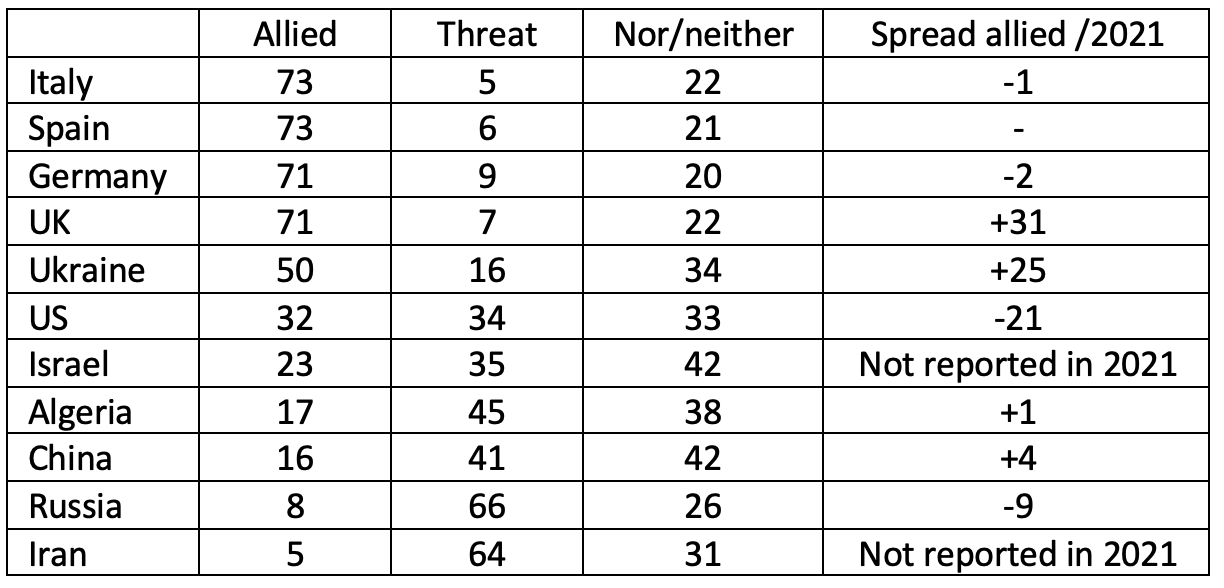
An opinion poll by Tolula-Harris-Interactive provides a wealth of information on how the French view their place in the new international context[1]. When asked how they perceive different countries in terms of their friend-or-foe relationship with France, three categories of countries can be distinguished. First, European countries. The French overwhelmingly view them as allies, whether they belong to the European Union (Italy, Spain, and Germany) or not (Great Britain). It is worth noting that, compared to the first wave of the 2021 survey, trust in Great Britain has increased by 31 points, as if Brexit were a thing of the past. Ukraine can be included in this group; it, in turn, gained 25 points compared to the period before the launch of Russia’s “special military operation.”
The second group includes the United States, Israel, Algeria, and China. Responses are distributed across the three possible answers, but the perception of a threat slightly outweighs that of an ally. Compared to the previous survey, the United States has dropped by 21 points. Only one-third of the French now view the United States as an ally. It is likely that a similar decline would have been observed for Israel had that country been included in the previous survey.
The third group includes Russia and Iran, which are overwhelmingly viewed as a threat, with Russia having lost another nine points compared to 2021. We thus observe that the French have adjusted their perception of reality in response to changes in the international situation: on the one hand, far fewer now view the United States as an ally, and on the other, they have clearly sided with Ukraine against Russia.
Table 1. Allied and threatening countries (%)
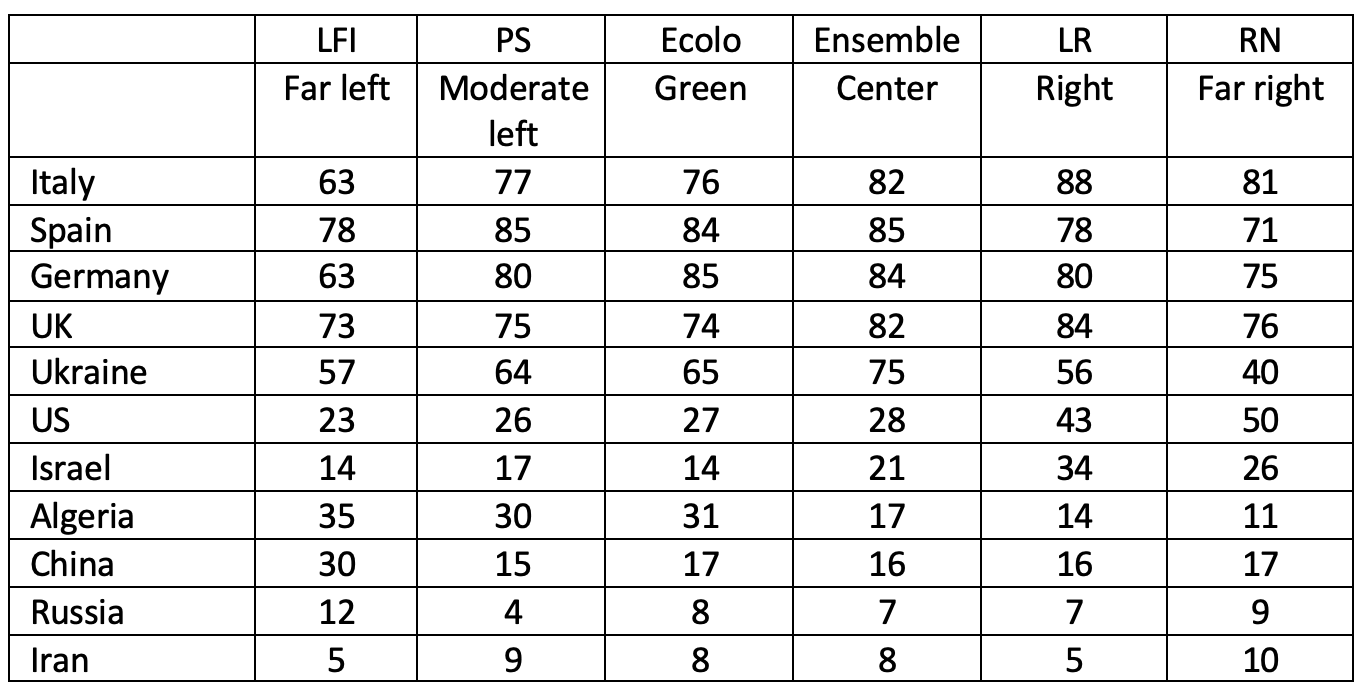
Another important observation: despite the differences among respondents based on their partisan affiliation, the most striking finding is that this variable introduces only minor differences (Table 2). In the first group of countries, these differences are negligible: regardless of their partisan affiliation, the French overwhelmingly consider European countries to be our allies. This includes Ukraine, and for that country, the proportion reaches as high as 57% among those close to LFI and 40% among those close to the RN (as for Russia, only 9% of those close to the RN and 12% of those close to LFI consider it an ally). As for the United States, only half of those close to the RN consider it an ally.
It is both surprising and reassuring to observe that, on these fundamental issues—and despite their differences on domestic policy matters—the French are largely united in their view of Europe as a protective space.
Table 2. Countries considered allies by partisan affiliation (%)
We then come across a contradiction. We might have thought that, under these circumstances, the French would be committed to continuing European integration. However, when asked what our foreign policy priorities should be, they seem to be more than cautious on the matter (Table 3). Only 19% want to “advance European integration.” Only those close to the Greens and the centrists of the Ensemble party are more likely to express this view, though even among them, a majority does not support this proposal.
Table 3. Foreign policy priorities: “Advancing European integration” (%)

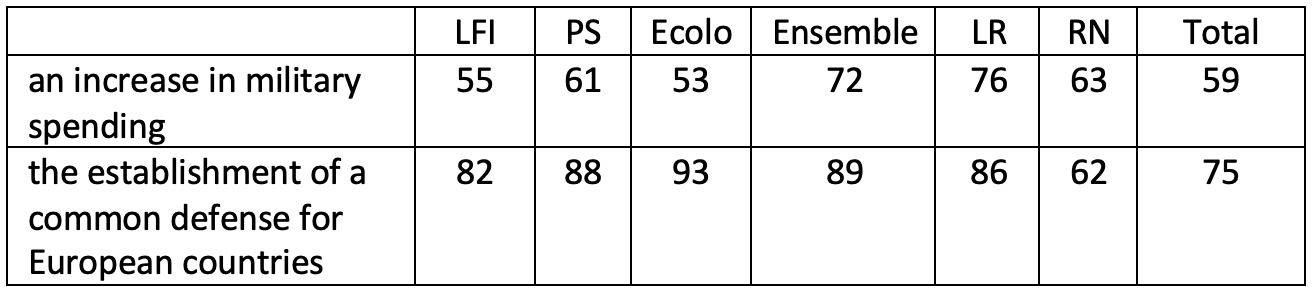
Should these figures be interpreted as indicating that the French are opposed to strengthening cooperation among European Union countries? Certainly not (Table 4). In fact, regardless of their partisan preferences, they overwhelmingly support the establishment of a common defense for European countries, which would represent a crucial step forward in European integration. It is worth noting here that 82% of those aligned with LFI and 62% of those aligned with the RN support this idea.
Perhaps, then, we need to look for other explanations for this reluctance to “advance European integration.” This phrasing of the question may have been understood to mean the continued expansion of the EU, and we know that the French are not in favor of it. Another explanation could be that this reluctance pertains to the Union itself as an institution, whose operations are perceived as too bureaucratic and whose institutions are seen as too distant from citizens. In any case, it seems clear that the French believe the EU is the most suitable framework for developing our defense, whether the leaders of La France Insoumise and the National Rally like it or not. They have long held the same view regarding currency, showing strong support for the euro. Thus, when it comes to the two pillars of sovereignty—defense and currency—they favor federalization at the European level, seeing no contradiction between national sovereignty and European sovereignty in these areas.
Table 4. Support for … (%)
The French and the Defense of the West
The French do not view Europe as the sole geographical framework for their defense. More broadly, they rely on the Atlantic Alliance. Indeed, in the event of a military attack on France, they also expect assistance from NATO and, to a lesser extent, from the United States (Table 5). In their view, therefore, it is the West itself that constitutes the framework for their security. While they no longer consider the United States an ally today, they do not seem to have given up on the North Atlantic Alliance, as if Trump’s America were, in their eyes, an anomaly destined to disappear one day.
Table 5. In the event of a military attack on France, assistance is expected from (%)

These data lead us to believe that political parties and figures who support European integration and the defense of the Western world are likely mistaken in justifying their caution—or even their timidity—by citing their perception that the French are attached solely to national sovereignty, when in fact the French may be ahead of them, even if the EU, as it currently functions, does little to satisfy them.
Did you enjoy this article? close




[1] Survey conducted from May 5 to 11 among 1,240 people.