Europe and the choice of the next UN Secretary-General edit
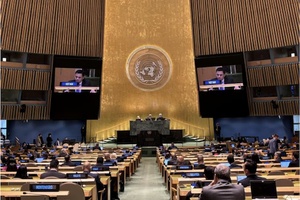
The United Nations was built on a principle: states must provide a legal basis for the use of force. That principle is now under direct assault. On 28 February 2026, the United States and Israel struck more than twenty sites in Iran, following the collapse of Omani-mediated nuclear negotiations. Iran retaliated with missiles and drones against Israel and American installations in the Gulf, violating the sovereignty of several states. That same day, Secretary-General Guterres addressed the Security Council in emergency session. Invoking the prohibition on the use of force, he declared: “International law and international humanitarian law must always be respected.” He condemned the US-Israeli strikes, then the Iranian retaliatory attacks.
Against this backdrop, Europe should be paying far closer attention to a process it has largely ignored: the ongoing selection of the next United Nations Secretary-General.
Under Trump, Washington has moved from treating its multilateral commitments as optional to launching what American doctrine itself describes as a war of choice. When the principal architect of the post-1945 order disregards the law, others learn fast. In such a world, the UN Secretary-General, the last universally mandated individual voice, has become indispensable for demanding that the use of force be grounded in law.
International law still performs its primary function: enabling states to coexist, cooperate, and settle disputes in the absence of a higher authority. It is, however, losing its hold over those it was meant to bind. The permanent members of the Security Council (P5) use the veto to shield themselves and their allies from accountability; Washington has withdrawn from major international organisations and agreements. Yet to reduce international law to its coercive dimension alone is to overlook its other sources of authority. Guterres warned that some believe “the force of law should be replaced by the law of force.” Even hypocrisy sustains the law: the act of justification acknowledges a norm against which power can be held to account. The real danger lies in abandoning justification altogether.
The strikes against Iran crystallise that danger. Washington invoked a shifting array of justifications so varied and contradictory that numerous independent legal authorities judged them insufficient under the Charter. Israel’s self-defence arguments are likewise contested; yet the very fact that they were invoked shows that law still structures the debate. When Guterres stated, with regard to Gaza, that “even war has rules”, he was defending precisely this function of the Charter. It is this constraint that an American president who claims to “have no need for international law” now threatens.
Gaza illustrates the consequences of abandonment. Security Council Resolution 2803 (2025) established a “Board of Peace” formally authorised by the UN but designed to operate outside its oversight mechanisms. The Board is mandated to operate in Gaza until the end of 2027 under a separate charter designating Trump as inaugural chair, vested with a veto and control over succession. That charter makes no reference to international humanitarian law or Palestinian self-determination. France, Germany, the United Kingdom and others refused to join, unwilling to legitimise a structure beyond all UN oversight. Their refusal was principled but reactive: a rejection without an alternative demand.
The Board demonstrates how UN authorisation can concentrate power while hollowing out the Charter’s constraints. Once such structures can be created under the United Nations name, the role of the Secretary-General becomes all the more indispensable. The United States is now waging war against Iran, while the Security Council, blocked by a potential American veto, cannot act.
In a world where powerful states treat legal argumentation as optional, the Secretary-General, as custodian of the Charter, must demand that they answer to it. Guterres’s mandate ends on 31 December 2026; the succession process, launched in November 2025, is decisive. Yet the letter opening that process calls for “leadership qualities” and “experience in international relations,” without mentioning independence from the P5 or commitment to international law.
Four candidates have been put forward: Michelle Bachelet, Rafael Grossi, Rebeca Grynspan, and Macky Sall, three Latin Americans and one African. No front-runner has emerged. Candidacies were to be submitted by 1 April; the Security Council selection is expected by the end of July, and the formal appointment by the end of 2026.
The EU presents itself as a guardian of the Charter, yet the selection of the next Secretary-General is absent from European Council conclusions and from the EU’s stated priorities at the United Nations. Its response to the strikes on Iran reveals the same failing. The EU condemned Iranian retaliation as “inexcusable” violations of sovereignty without characterising the US-Israeli strikes as violations of international law, even though the Secretary-General, legal scholars, and states such as Spain and South Africa had done so. As of 9 March, fifteen countries explicitly supported the military campaign, representing 8% of the world’s population. Europe constituted the largest regional bloc of support; no Middle Eastern government backed it. Selective condemnation is not a legal posture Europe can sustain. It also weakens Europe’s voice when the time comes to defend, in the choice of the next Secretary-General, the very qualities it claims to embody.
Many justify this restraint on grounds of realism: the Security Council selects the Secretary-General, and the EU has no formal role. This confuses institutional competence with political responsibility. A Secretary-General chosen to offend no major power will not demand a legal basis for the use of force. Such a figure cannot compel compliance with the law, but can prevent the normalisation of silence, the silence that allows abandonment to harden into a norm. A discussion among European leaders on the qualities required, in particular independence and commitment to international law, would not challenge the formal process; it would clarify Europe’s expectations and signal the constitutive significance of this selection. EU member states should use the interactive dialogues with candidates, scheduled for the week of 20 April, to press hard questions on these criteria, and ensure that European votes in the Security Council reflect them.
The Secretary-General is the last universally mandated individual voice to demand that power answer to law. If that voice falls silent, it will not be the law that failed the world, but the states that failed the law.
Reinhold Brender, PhD, former EU official, Senior Associate Fellow, Egmont (Royal Institute for International Relations, Brussels).
Did you enjoy this article? close