Playing the long game: China’s space strategy edit
China stands at the forefront of a rapidly shifting global landscape shaped by Critical and Emerging Technologies (CETs) and by the accelerating commercialisation of space. As nations around the world compete for leadership in advanced technologies—from AI and quantum systems to autonomous vehicles and space platforms—China has articulated and deployed a comprehensive strategy designed to secure its position as a dominant space power. The nation’s approach blends long-term state planning, massive investments in knowledge-intensive industries, control over key supply chains, and a deliberate commitment to the development and integration of emerging technologies across civilian, commercial, and defence sectors.
The heart of China’s space strategy is tightly interwoven with its ambition to become a global technology leader. Over the past decade, China has expanded its national space capabilities dramatically, not only entering but recasting the now, multi-nation “space race”.
In earlier eras, the United States and the then-Soviet Union were the sole major competitors beyond Earth’s atmosphere. Today, there are many more players, along with private as well as public investment and joint-partnerships. Space agencies have proliferated and space programs are now widespread. The US, China, Japan, Russia, and France account for the bulk of global government expenditure on space programs, followed by the EU. And a growing number of new comers, such as Saudi Arabia, are actively developing national space strategies and pledging billions in investment. Nonetheless, there is no question that China has become a standout amongst the many nations that now see space as both an arena of geopolitical competition and a new frontier of scientific, industrial, social and economic opportunity.
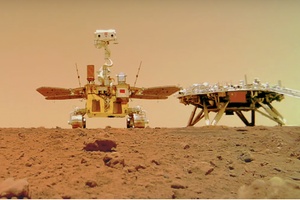
China’s recent milestones underscore this ambition. In 2021, shortly after NASA’s Perseverance rover touched down on Mars, China successfully landed its own Zhurong rover on the red planet. This achievement was more than symbolic. It demonstrated China’s increasing proficiency in high-complexity, high-risk space missions and its capacity to integrate advanced robotics, sensing, AI, and manufacturing systems—technologies central to the CET landscape. Zhurong’s data, including emerging evidence suggesting ancient beaches on Mars, reinforces China’s aspirations not only to explore but eventually help shape future extraterrestrial environments.
For China, Mars is a proving ground for broader ambitions that include deep-space exploration, planetary science, and future resource access. And in late 2022, China completed the Tiangong space station, giving it a key testbed for technologies needed for future space explorations and for better understanding the long-term effects of spaceflight on humans.
These achievements cannot be separated from China’s broader CET ecosystem. The country has built an expansive, highly skilled workforce that allows it to execute complex technology programmes at scale. More than 40% of Chinese university graduates earn STEM degrees, far outpacing the proportions in the U.S., Europe, and Japan. And Chinese international students are now showing greater interest in STEM studies in addition to established preferences for business and legal courses.
Significantly in August 2025, the Ministry of Education also released a three-year action plan for ‘adjusting and optimizing’ university curricula to better align with the high-level skills needs of China’s strategic industries and with national development goals. Fundamental sciences and fields such as AI, biotechnology and integrated circuits will gain resources, ‘oversupplied majors’ will be overhauled. All of this, aided by the development of a national big data platform tracking supply and demand across university programmes.
China also hosts half of the world’s top 20 science cities, illustrating both the geographical depth and concentration of its research capacity. And the Dongbi Index report released earlier this year shows that there are now more ‘high level science and technology talents’ in China than in the US. This is likely to be augmented from the growing exodus of top tier scientific talent from the US, as reduced funding, increasing political pressures and heightened uncertainty for researchers, further escalate under the Trump Administration.
This scientific and technology engine provides the intellectual backbone for China’s space strategy as well as its efforts in AI, biotech, quantum technology, advanced materials, and green energy. And China’s manufacturing and resource advantages further boost this strategic positioning. The country overwhelmingly dominates the global production and supply chain for rare earth elements—materials essential for advanced sensors, magnets, batteries, computing hardware, and defence systems. Such dominance provides China with powerful leverage in the development of space-related technologies, from guidance systems to satellite components and autonomous robotics. This foundation complements China’s long-running national strategies, including the landmark “Made in China 2025” plan, which prioritises high-tech manufacturing sectors crucial for both terrestrial and off-planet innovation.
China’s support for CETs extends beyond isolated funding programmes to encompass an integrated policy framework. For example, earlier this year China released a global action plan for artificial intelligence, intended not only to embed AI across domestic industries but also to export AI-based support to less developed economies. This aligns with China’s broader strategy to position itself as both a technological leader and a global partner—a dual approach that strengthens its international influence in the unfolding space economy. As AI becomes increasingly essential for spacecraft navigation, autonomous robotics, satellite networks, and debris monitoring, China’s AI strategy doubles as a space strategy.
The last decade has also seen the rise of ‘deep tech’ enterprises internationally. These entities, often start-ups, push the boundaries of science and engineering to bring novel and scalable solutions to big challenges in areas such as energy, food, space and disease. The rise of deep tech enterprises in China has further enhanced its ability to compete in space-related innovation. Deep tech companies in fields like quantum computing, biotech, aerospace, and advanced materials, benefit from significant state support. In line with its indigenous innovation strategy China has established a US$138 billion government-backed fund to accelerate breakthroughs in what President Xi Jinping in 2020 termed “future industries,” including SpaceTech. Chinese startups, supported by this policy environment, concentrate investments on deep tech and industrial advances that complement national aerospace goals.
China’s public investment in R&D is also notable. The country’s rate of investment is about twice that of the United States when adjusting for cost (R&D is cheaper in China), and by 2015 China was already outpacing the U.S. in patents by roughly 90%. Such sustained investment provides reliability—an essential ingredient for space programmes that require decades-long continuity, deep capital reserves, and tolerance for experimentation and failure.
China has strategically embedded its space ambitions within the global context of the emerging space economy. As space becomes central to scientific discovery, national security, and commercial opportunity, countries worldwide are launching national space programmes, drafting industrial strategies, and forging new partnerships between public agencies and private companies. The global space economy is expected to reach USD 1.8 trillion by 2035, fuelled by satellite services, in-space manufacturing, energy innovations, tourism, and low-Earth-orbit industries. China is deeply integrated into this dynamic, competing directly with other space powers—especially the U.S.—in fields such as satellite constellations, robotics, and AI-driven platform technologies.
China’s growing footprint in space is also entangled with the increasingly complex challenge of space debris. Although the U.S., Russia, and China collectively generate the majority of orbital debris, regulatory responsibility for mitigation remains unclear. This contributes to heightened risks for satellites and missions worldwide. For China, the issue of space debris is both a vulnerability and a strategic variable: debris can jeopardize China’s own space infrastructure, but the regulatory ambiguity also creates an arena in which major powers seek to shape global norms in line with national interests.
Altogether, China’s strategy reflects an understanding that CETs and space technologies are inseparable—and that leadership in one domain reinforces leadership in the other. Emerging technologies such as AI, quantum systems, autonomous robotics, and advanced materials are essential for launching, navigating, and maintaining spacecraft; for collecting and analysing vast data from planetary missions; and for building the infrastructure needed for future off-planet exploration or resource extraction. China’s integration of these technologies into a holistic strategy clearly gives it a distinct competitive advantage in the race for space.
This has not been lost on Europe. In June 2025 the European Commission released its EU Space Act and space industrial strategy with an explicit ambition to take a lead role in the rapidly growing space economy. And the EU’s proposed Competitiveness Compass sees a European Competitiveness Fund which will invest in strategic technologies such as AI, quantum computing, robotics and semiconductors and with defence and space targeted as one of the four focus areas. In late November, EU member states also agreed to the ESA request to increase spending on space by approximately 30% over the next three years.
France has long been a leader in the European space economy, with significant government investment and an industrial base accounting for more than half of the European space sector. However, most recently President Macron acknowledged the imperative of recognising that: ‘space is no longer a sanctuary; it has become a battlefield’ and that France needed to defend its sovereignty in accessing space. In launching the National Space Strategy 2025-2040 in mid-November President Macron emphasised the importance of collaboration with European partners, targeted talent development and the ability to supply critical technologies to support both defence and civilian priorities in space, both areas being earmarked for significant spending increases.
Just two weeks later, the China National Space Administration (CNSA) announced that it had established the Commercial Aerospace Department to oversee China’s fast growing commercial space sector, which has more than 600 entities. This initiative is directly linked to the Action Plan for Promoting the High-Quality and Safe Development of Commercial Space (2025–2027) aimed at expanding the commercial space ecosystem and directly integrating it into China’s national space strategy. Like France, China also sees partnerships as important. And in early 2025 CSNA indicated its openness to deepening international collaborations to further space explorations, promote resource sharing and expand knowledge for the benefit of humanity. A number of international institutions, including from France, Japan, Pakistan and the US have since collaborated on lunar samples collected by China’s Chang’e-5 mission in 2020.
When it comes to the framing, financing and implementing of strategic and coordinated policies for CETs and space, China has already surpassed many competitors. Indeed, it's not so much a question of whether other nations with ambitions for the space economy can actually play catchup to China but rather whether they are even competitors in the same race. And as one of the world’s oldest continuous civilisations, with a written history dating back over 3,500 years to the Shang Dynasty, there is the overarching reality that China clearly knows how to play the long game.
Did you enjoy this article? close