“Ultimately, the Government Gets to Choose the Message it Wants to Convey” edit
President Donald Trump’s daily barrage of tweets, posts, and interviews may appear contradictory and chaotic. However, all reflect Trump’s core motivations: to increase his own notoriety, status, power, and wealth; as well as to achieve his far-right Make America Great Again (MAGA) ideological project involving Christian, nationalist, racist, xenophobic, misogynistic, and authoritarian values. This article analyzes attempts by Trump and his epigones to control popular and official narratives regarding this dual agenda. Success in shaping Americans’ perceptions and beliefs regarding Trump and the character of the United States will help shape and reshape the underlying material reality. The process was described by sociologist W.I. Thomas in 1928: “If men [and women] define a situation as real, it is real in its consequences.” (George Orwell’s 1984 is another useful guide to the Trump administration’s communication strategy.) The media-savvy Trump, who starred in a popular TV reality show for eleven years, has brilliantly deployed rhetoric to promote himself and the MAGA project. The campaign of self-serving lies and suppression of inconvenient truths and criticisms tacitly contradict the popular adage claiming that sticks and stones —but not words— can cause great harm.
Elements in Trump’s Campaign to Control the Narrative
Whitewashing past and present history. Trump and his administration have relentlessly sought to delete references to America’s past and present injustices and present a sanitized, mendacious, and bigoted depiction of American history. Consider Trump’s Executive Order of March 2025, “Restoring Truth and Sanity to American History,” that directed federal agencies to remove from public facilities any material that “inappropriately disparage[s] Americans, and instead focus on the greatness …. [of the United States].” Erasing public references to aspects of American history that the administration dislikes is an attempt to erase them from public memory altogether, as when the National Park Service removed an exhibit at George Washington’s home in Philadelphia depicting his eight enslaved house servants. When a lawsuit challenged the removal, a government lawyer responded, “Ultimately, the government gets to choose the message it wants to convey.” (However, the challenge succeeded, and a judge ordered the exhibit to be restored.) Another example was when the National Portrait Gallery of the Smithsonian Institution, a public institution, removed mention of Trump’s two impeachments—followed by Trump’s dismissing the Gallery’s director. (Here and elsewhere, space precludes providing extensive empirical evidence of the processes identified.)
Taking metaphors literally: Performative symbolism. The Trump administration has interpreted metaphorical concepts literally to advance its agenda. For example, after alleging that the United States is involved in a “war on drugs,” Trump invoked the Constitution’s grant of presidential war power to direct the destruction of civilian boats in the Caribbean and Eastern Pacific, and murder over 150 crew members (justified by the baseless claim that they were enemy combatants).
The war metaphor can also be applied inward. In response to protests against Immigration and Custom Enforcement (ICE) agents flooding American cities, Trump declared, “It’s a war from within” and dispatched federal and national guard troops in full battle gear and equipped with machine guns to patrol Democratic-leaning cities. The made-for-media spectacle was designed to signal that lawful protests will engender a violent state response—as in fact occurred when many peaceful protesters were arrested and two were murdered in Minneapolis by ICE officials. A political analyst remarked that the “killing was emblematic of its true mission: to stage a spectacle of cruelty against Trump’s dark vision of America.” (Lydia Polgreen, “In Minneapolis, I Glimpsed a Civil War,” The New York Times, January 24, 2026)
Timing is important. The Trump administration recognizes that initial impressions of an event help shape popular interpretations, even if those impressions are later refuted. For example, when Renee Goode and Alex Pretti were murdered by ICE and Border Patrol agents, the administration described them as “would-be assassin[s]” and “domestic terrorist[s].” Although patently false, these outrageous claims initially served as the lens through which many viewed the murders.
A (doctored) picture is worth a thousand words. A case in point: following the arrest of Nekima Levy Armstrong, an African American civil rights attorney and activist, for peacefully protesting ICE’s actions, the White House photoshopped and posted on the White House social media account an image falsely depicting her as uncontrolled and hysterical. In fact, Ms. Armstrong acted with great dignity after her arrest. Further, the accompanying post maliciously described her as a “far-left agitator” who was “orchestrating church riots in Minnesota.” President Trump claimed that she and other arrested protesters were “agitators and insurrectionists” who should be “thrown in jail or thrown out of the Country.” When a White House official was asked to comment, she snapped, “Enforcement of the law will continue. The memes will continue.”
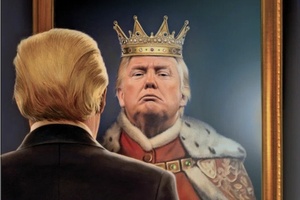
Rhetoric and actions that coarsen American culture. Trump’s brazen, obscene, and bigoted public rhetoric contrasts with centuries of presidential discourse. It is probably intended to convey his anti-elitist and populist commitment. He routinely describes critics as “sick” and “lunatic Marxists.” In a public cabinet meeting, he called Ilhan Omar, a Democratic member of Congress, “garbage.” He has described immigrants as “snakes” with “bad genes,” and claimed (a la Nazi terminology) that they are “poisoning the blood” of America. In response to the nationwide “No Kings Day” protests last October, he posted on social media a video of himself wearing a crown, flying above demonstrators, and dumping immense loads of feces on them. His messages often have an ominous intent, as when he posted an online threat regarding six Democratic members of Congress (all former military officers) who released a video advising active service members to disregard illegal orders: “Each one of the[se] traitors to our Country should be ARRESTED AND PUT ON TRIAL.” The Department of Justice (DOJ) soon heeded Trump’s request and sought to indict the six. However, two grand juries refused—in striking contrast to most cases where the federal government seeks indictments.
Trump’s coarsening of culture to advance his personal and populist agenda extends to the message conveyed by initiating--without required congressional consultation and authorization--the largest “renovation” of the White House since its near destruction in the War of 1812. The project will replace the East Wing and Rose Garden with a mammoth ballroom (larger than the White House Mansion and West Wing combined) that will reflect Trump’s preferred style of gilt and glitz evident at Mar-a-Lago. A related example of using architecture to convey a message is his proposal (again without congressional involvement) to build a 250-foot-high arch modeled on Paris’ Arc de Triomphe. The monument will overwhelm nearby iconic Washington memorials.
“The medium is the message” (to borrow the dictum of media analyst Marshall McLuhan). Trump’s favorite media are tweets, podcasts, online posts, and TV interviews conducted by sycophants. The medium and the content reflect and promote an authoritarian populist message. So too is the fact that he conducts cabinet meetings on live TV, at which (a la North Korea’s Kim Jong Un) cabinet secretaries vie to shower the president with praise. Political analyst Ezra Klein comments that “The joke of Trump’s cabinet meetings is that no one is joking. These meetings are not just a performance; they are a culture. Trump’s favor is won through demonstrations of loyalty rather than competence. The president wants parades, not process, and that is what he gets.” (“Ezra Klein, “Trump Has Overwhelmed Himself,” The New York Times, February 1, 2026.) The anti-elitist, populist message is that policy-making is the product of the omniscient leader’s intuitions—which are superior to the knowledge provided by “his” generals, scientists, and policymakers, as well as by independent experts
The cash and name game. Trump is unabashedly exploiting his presidency for self-aggrandizement. His behavior conveys the message that it is perfectly legitimate to use public office for private enrichment. In years past, Trump leveraged his notoriety as a popular TV personality and first-term president by franchising his name for casinos, golf courses, Trump University, Trump Steaks, and luxury apartment buildings. In his second term, the scale of corruption has reached unprecedented heights, dwarfing those of any past president. By illegally and unethically intertwining his public and private roles, Trump’s fortune since his re-election has increased by four billion dollars--with far more lying ahead. This has resulted from Trump licensing his name and investing in cryptocurrency, luxury resorts, and golf courses, usually partnering with private investors and foreign governments (especially the U.A.E. and Saudi Arabia) who seek favors from the U.S. government. The Trump family’s most lucrative venture is cryptocurrency. Its holdings skyrocketed from negligible amounts prior to Trump’s re-election to $6 billion currently, following the creation of the $Trump meme coin and World Liberty Financial.
Trump has also ramped up efforts to boost his public acclaim, partly fueled by the attempt to erase from public memory his two impeachments and 2020 electoral defeat. One element involves affixing his name to public facilities. As the president remarked, “You’ve got to put your name on stuff or no one remembers you.” (Quoted in Peter Baker, “A Superman, Jedi and Pope: Trump’s Self-Mythology,” The New York Times, February 16, 2026.) Consider his renaming the John F. Kennedy Center for the Performing Arts, a renowned Washington, D.C. cultural institution created by Congress to honor the assassinated president. After Trump was re-elected, he dismissed most Kennedy Center board members and replaced them with allies. The board promptly renamed the Center (without congressional authorization) the Trump-Kennedy Center for the Performing Arts. It is unprecedented for public facilities to be renamed for incumbent presidents—yet in this case that honor was proposed by the incumbent president himself! When a host of artists canceled scheduled performances at the Center in protest, Trump responded by closing the Center for “renovations” for two years—tacit recognition of the damage caused by his megalomania. He is also planning to put his name and image on two newly created coins—again, an honor never before bestowed on a living president.
Dominating influencers
The Trump Administration’s campaign to control perceptions and shape public opinion involves suppressing inconvenient truths that challenge the official narrative. For example, the White House has ordered federal agencies to reject any applications for federal grants for diversity, equity, and inclusion (DEI) programs, as well as for research on climate change. It ended collecting and publishing data involving food insecurity, misconduct by law enforcement officials, and infant and maternal mortality, presumably calculating that if there is no public record of these problems, concern about these problems will cease to exist.
The Trump administration has attacked key institutions that potentially challenge the official narrative. They include the news media, universities, and law firms.
The news media. The Trump administration has trampled on the First Amendment’s prohibition of government limiting free speech. A New York Times editorial of February 24, 2026, observed, “The Trump administration has… weaponized the [federal] agencies [that regulate public broadcast media] and transformed them into instruments of ideological enforcement.” Trump and the executive have engaged in a relentless attack on independent sources of investigation and reporting, an attack far greater than precedents like the Red Scare of the 1950s. The government ended public funding for nonprofit TV and radio networks that for generations have presented reliable news coverage. Trump has sued a host of media for billions of dollars in retaliation for their critical coverage, and federal agencies have threatened to deny renewal of broadcast licenses to radio and TV networks that broadcast critical material.
Trump also engages in personal attacks and insults. He characterizes news reports that contradict his message as “fake news” After successfully pressuring one TV network to cancel a late-night talk-show host, he posted, regarding a host on another network: “fire him, IMMEDIATELY!” The government violated a law shielding journalists by searching a journalist’s home and seizing her computer, telephone, and written records.
Major news organizations have engaged in self-censorship to placate the president by canceling critical investigative reports and critical late-night talk shows. In a decision whose timing raises questions, the Gallup polling organization recently discontinued its highly respected [federal] presidential popularity polling at a time when Mr. Trump’s popularity has sunk to historic lows.
Universities. An inherent challenge to the Trump administration’s quest to define reality is posed by universities’ core mission of seeking truth by their teaching and research. On vitally important topics like the reality and danger of climate change, efficacy of vaccines, impact of tariffs, integrity of law enforcement, and character of social justice, universities embracing their mission necessarily clash with the Trump administration’s far-right messages and policies. In order (ostensibly) to combat campus antisemitism and discrimination against white students, the administration has launched lawsuits against universities, withheld federal research funds, and required them to sign a “compact” to limit foreign student enrollment and reshape course curricula and university governance to align with its ideological agenda. Erwin Chemerinsky, dean of the University of California, Berkeley, law school, described these compacts as “extortion.”
Law firms. The administration has sought to deter several of the country’s most influential law firms from representing clients who challenge administration policies and actions. It has also demanded that these firms provide substantial pro bono assistance to Trump-friendly political action committees (PACs).
The State of the Union
Trump’s attempt to control the narrative is amply evident in his recent State of the Union address, the annual report that presidents deliver to Congress and the country. Most such speeches praise the condition of the United States and seek to inspire national unity. Trump’s address on February 24th—replete with mendacious, self-aggrandizing, and partisan claims--was in strong contrast to this pattern. The speech encapsulated every one of the elements analyzed here designed to enhance the president’s status and power. An example of mendacity was the president boast that “We will always protect Social Security, Medicare, Medicaid.” However, the president’s tax reduction bill passed last year is predicted to reduce future funding for Medicare, as well as reduce Medicaid funding by $1 trillion over the next decade that will deprive benefits to 10 million people.
Resistance. Trump’s campaign to shape public opinion and thereby reshape the United States has had an extraordinarily destructive impact in the brief period since he regained office. However, the project has only been partially successful. While some universities succumbed to the administration’s pressure, others have refused to bend. When the Pentagon required journalists to sign an agreement severely restricting what they could report, not one agreed and the mandate was withdrawn. The campaign to portray the violent assault on Minneapolis by ICE and Border Patrol as an attempt to restore law and order provoked massive resistance that forced the administration partially to capitulate. Scores of judicial rulings have checked the Trump administration’s suppression of messages that it opposes. Thus, while the trenches and fortifications of civil society (as Italian Marxist Antonio Gramsci called these bulwarks) have been weakened, they remain sturdy. Further, the tide appears to be shifting. Popular support for Trump and his policies was tepid when he regained office; it has further declined to an unprecedently low level. (Could his recent launching of a massive attack on Iran partly represent an attempt to divert attention from his domestic situation?) Meanwhile protests have been increasing, and the defection of some GOP leaders indicates that his own coalition may be crumbling. Public opinion polls currently suggest the likelihood of Democrats gaining control of at least one house of Congress if this year’s midterm elections were fairly conducted. However, complacency would be naïve: although Trump is not even halfway through his second term, he has already produced incalculable damage. Further, the prospects of a GOP defeat this November have spurred the administration to devise ways to ensure victory by foul means or fair (a topic beyond the scope of this article). The narrative and reality of what lie ahead remain wide open.
Did you enjoy this article? close