The Ghosts of Chernobyl edit
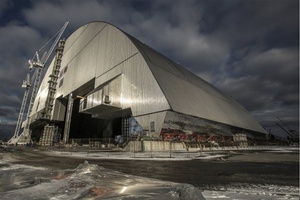
Prior to becoming a topic of controversy, the Chernobyl accident was captured on film in real time beginning on April 26, 1986. It has been featured in various documentaries and fictional films since then and its invisible cloud has come to symbolize a kind of apocalypse in the heart of Europe, in the confines of a Ukraine that would gain independence five years thereafter. Forty years hence, the power plant is under threat from Russia, after having been seriously damaged by a drone strike in 2025 that compromised its protective sarcophagus. The Chernobyl Museum, a living memorial to the disaster, was partially destroyed in Kyiv last May by Russian bombing[1].
“Chornobyl” was first mentioned in the Middle Ages as a village in Polesia before being transformed into a shtetl and then later becoming one of the major Hasidic centers of the mid-18th century, before being wiped off the map in World War II. Today, this place is symbolized by a massive sarcophagus haunted only by its own ghosts. But the nuclear accident continues to haunt our imaginations, appearing in numerous books and films. The nuclear power plant embodies various ominous symbols. Etymologically, “Chornobyl” could be translated as “And there was darkness.” In fact, the name Черно́быль (Ukrainian: Чорно́биль) is derived from a plant, the chornobylnik (“чернобыльник” / “полынь обыкновенная”: common wormwood), composed of “chorno” (black) and “byl” (stem), referring to the plant’s black stem. As for the nuclear power plant, it was named “Vladimir Ilyich Lenin.” To give a brief historical overview, this technological crown jewel of Soviet industry was dedicated to the founder of the USSR; the explosion of its fourth reactor foreshadowed—and perhaps hastened—the impending collapse of a Soviet system that was on its last legs.
Since 1976, following the construction of three other plants, the Chernobyl plant had been meeting the electricity needs of Ukraine’s 50 million inhabitants. Commissioned in 1984, the fourth reactor was a testament to the USSR’s technological advances at the time, prior to the installation of two additional reactors. But since April 26, 1986, Chernobyl has come to symbolize all the paradoxes of communication surrounding nuclear power—a form of communication that has become both visual and written, yet has remained at once visible and invisible. It bears witness to the profound rifts that existed in the USSR, and thereafter, between written and visual culture.
A Challenge for Local and Global Communication
Gorbachev came to learn the full extent of the Soviet system’s disinformation, its dysfunctions, and its disorganization because of Chernobyl. His policy of transparency (Glasnost), born in the wake of the disaster, shed light on the USSR’s ecological crisis and the collapse of its economy. The accident highlighted the system’s compartmentalization and the disconnect between high-quality Soviet basic science and its flawed applications[2]. The Soviet culture of secrecy was de facto fractured (even though there was a previous disaster in 1957, linked to the explosion at the Mayak radiochemical complex for reprocessing nuclear waste in the Urals, but was not revealed until 1989). Gorbachev had not yet been able to gauge the effects of Chernobyl as a ticking time bomb for the impending collapse of the USSR. Forced by the accident, he was compelled to implement a new policy of transparency, Glasnost. While some Soviet media outlets hinted three days later at an out-of-control nuclear disaster that was already spilling beyond the USSR’s borders, they failed to grasp the full implications of this in terms of information[3]. Chernobyl helped to free speech in a country that had been sealed off on a continental scale.
Gorbachev undoubtedly hoped to use the media to draw on a burgeoning public opinion to carry out his initial reforms. By addressing the Soviet people officially for the first time on television and calling for a massive mobilization outside of any bureaucratic channels, Gorbachev revealed only on May 14 the full extent of the disaster and its ecological impact. Yet long before Chernobyl, 40% of the urban population lived in devastated industrial areas where environmental degradation was becoming a fundamental threat to public health[4]. The legacy of heavy industrialization and forced collectivization in the 1930s—marked by unrestrained land irrigation and the use of defoliants—had polluted more than 30% of the land, as well as seas and rivers. The mines of the Donbass in Ukraine and those of the Kuzbass in Siberia leave behind obsolete industrial sites.
Moreover, the trauma of Chernobyl reignited many other concerns regarding widespread negligence that extended far beyond the management of nuclear sites alone. The entire USSR operated under a centralized model lacking effective environmental regulation. But after the collapse of the USSR, no post-Soviet state truly developed genuine decentralized environmental policies. Only international institutions, including the EEC—which would later become the EU—committed to providing substantial aid after Chernobyl, both financial and humanitarian, primarily as an attempt to secure nuclear sites that posed a threat to Europe, given the extent of the deterioration. Far from Lenin’s macabre sarcophagus in the mausoleum on Red Square, several billions were spent to construct other protective sarcophagi around the destroyed power plant—the first immediately after the 1986 explosion and the second in 2019, built to European safety standards thanks to a 1.5-billion funding from the EBRD and aid from Japan.
Cinematic Memories
“Miscellaneous news stories” were never reported in Soviet society, but information about Chernobyl soon thereafter became visual through television reports that conveyed images of a tragedy that had taken on global proportions. Later in 1990, a few films began to document and analyze in-depth the disaster. One notable example is the first major Soviet-American feature film, The Disintegration (Распад) (1990) by Mikhail Belikov, which, beyond depicting Chernobyl against a backdrop of heroism interspersed with archival footage, reveals the disintegration of Soviet society on a whole. A documentary, Pripyat (1999), by Nicolaus Geyrhalter, explores the ghost town and its few remaining inhabitants left to fend for themselves. Other documentaries and popular television dramas were followed by books and other written works, which were in turn adapted into various audiovisual formats. An example, would be a video game, based on the Stalker series, produced by the Ukrainian studio GSC and exported to Europe, serving as a tool of soft power for Ukraine [5].This type of game draws from both Tarkovsky’s eponymous film (1979)—combining metaphysical and philosophical themes with the issue of labor camps—and the Soviet science fiction works of the Strugatsky brothers which were very popular in the USSR in the 1970s[6]. These video games portray Chernobyl as a random yet dangerous treasure hunt to explore. For example, Shadow of Chernobyl (2007) depicts the hunt for mutants in the devastated zone through a series of adventure missions. Others, such as Clear Sky (2008) and Call of Pripyat (2009), explore the zone through the lens of paranormal phenomena. Following in this same vein—as part of the Stalker series, which sold millions of copies worldwide—then came Chernobyl VR Project (2016), Radiation City (2018), Chernobylite (2021), and Heart of Chornobyl (2024). In the United States, Bradley Parker’s Chronicles of Chernobyl (2012) takes up the torch of all these disaster narratives in the form of a horror film.
The first truly substantial and informative films were produced twenty years after the disaster beyond the post-Soviet world; they piece together the narrative of Chernobyl. The documentary The Battle of Chernobyl (2006) made by the Franco-Australian director, Thomas Johnson, by employing archival footage and interviews, accurately reconstructs the events as a true race against time. This documentary was followed by the Anglo-American HBO series Chernobyl (2019) by Craig Mazin which became a global hit with a cumulative viewership of 18 million. Spanning five 60-minute episodes, this breathtaking series—filmed in Lithuania at the Ignalina nuclear power plant, a sister facility to Chernobyl—combines fictional storytelling with the reality depicted in the documentary The Battle of Chernobyl and explores the more political aspects of the disaster and its consequences. Prior to the Russian invasion of 2022, these films helped fuel a surge in organized tours to the sites featured in Chernobyl Diaries (2012). The American series, criticized for certain historical inaccuracies, was deemed biased by the Russian government. During the occupation of Crimea, a counter-series was produced in Russia for television: Chernobyl: Exclusion Zone (2014–2017), by Anders Bank and Pavel Kostomarov, depicts the disaster in three episodes through a fantastical, conspiracy-theory-driven lens; this time implicating the CIA in the nuclear disaster and that of the collapse of the USSR. In Russia, another fictional disaster film, Chernobyl (2021) by Danila Kozlovski, revisits the accident, this time focusing on the firefighters elevated to hero-status in the Soviet tradition. But more recently, Chernobyl: The Lost Tapes (2022), a British documentary by James Jones, unearths other, lesser-known archival footage to contradict these official narratives. Ukrainians did not lag behind; with a few rare documentary films, they drew on eyewitness accounts, such as Radiophobia (2006) and Bastion of the Exclusion Zone (2026) by Olesia Morgunets-Isaienko. But there have also been fictional films such as Aurora by Oksana Baiarak (2006, submitted to the Oscars), which tells the story of a child exposed to radiation and treated in the United States, and Nuclear Waste (2012) by Myroslav Slaboshpytskiy, which won an award at Locarno. In 2026, marking the 40th anniversary of the event, several more documentaries were produced and broadcast in Europe, often following the same narrative framework centered on archival footage from the first global broadcasts of the disaster[7].
Making an Invisible Event Visible
Two particularly iconic works—the documentary, The Battle of Chernobyl (2006) and the American fictional series, Chernobyl (2019)—recounted in their own way, the day-by-day story of the explosion, its consequences and its legacy. Fiction and documentary converge here. Both works highlight the tension between the event’s near-invisibility over time and its visibility which gradually took on a cinematic form. The power plant was just three kilometers from its ancestral site, fifteen kilometers from Prypiat—a new Soviet city of 43,000 residents, evacuated in two days, which employed the majority of its workers located one hundred kilometers from Kyiv. The residents would never return, as shown in the film Prypiat, which revisits the site of this abandoned city, now overgrown with vegetation.
These two films provide a detailed account of the sequence of events. Reactor Four exploded on April 26, 1986, at 1:23 a.m., during what was supposed to be a routine test to conserve energy of an autonomous power supply. In the middle of the night, several explosions occurred in quick succession, and the situation spiraled out of control. Mikhail Gorbachev, who had just come to power in 1985, was notified of the accident around 5 a.m. The effects of the massive fire—which local firefighters were battling without protective gear—were downplayed to him. No specific instructions were actually given at that time, even though the radiation level measured by faulty detectors was already over 2,500 roentgen at the site—compared to a tolerable level of 2 roentgen per person per year. The radiation levels continued to rise and quickly exceeded those measured in Hiroshima after the atomic bomb.
Thirty hours after the explosion, people began to realize the enormity of the situation. The fire at the reactor core—now buried 14 meters underground beneath indescribable rubble—continued to spread despite the establishment of an Assessment Commission at the Kurchatov Institute in Moscow, which quickly proved incapable of responding or relaying any information. In this Soviet system dominated by lies and mismanagement, officials continued to lie about the gravity of the situation in order to cover it up. Within two days, radioactivity had already contaminated the entire surrounding area and irradiated the first rescue workers who arrived by helicopter. As this initial rescue phase unfolded, an entire battalion of firefighters was sacrificed. No official information is released despite the arrival of thousands of masked soldiers. Gorbachev therefore orders the local KGB to take charge of the situation and relay the information. A translucent radioactive plume over 1,000 meters high contaminates the air, while 1,200 metric tons of radioactive material continue to burn at the heart of the plant at a temperature of 2,000 degrees without adequate means to combat the fire. Two days after the incident, the radioactive cloud had already reached Sweden, Poland, and the Baltic states. Yet no information had been officially released. The FOI Institute in Stockholm—by then already reached by the cloud—and then American spy satellites photographing the gutted core of the plant eventually alerted the International Atomic Energy Agency in Vienna.
At the site, emergency measures had to be improvised to contain the fire, shut down the reactor, and prevent the radioactive clouds from spreading by wind. Hundreds of pilots were requisitioned, some transferred from Afghanistan, to assist local rescue efforts with about thirty daily helicopter flights. Cubic tons of sand were dropped by helicopters in successive flights to neutralize the radioactivity. All the pilots and soldiers on the front lines were exposed to radiation and were sent to Hospital No. 6 in Moscow, the country’s only specialized facility for treating their burns and rapidly progressing bone marrow degeneration. Many firefighters and pilots died quickly, fallen victim to enormous doses of radiation and severe burns.
The plan was then to seal the crater by pouring lead into the reactor to reduce radioactivity. Six hundred pilots were mobilized for this task and were exposed to radiation while dumping 2,400 metric tons of lead to limit radiation levels; the lead then vaporized into the atmosphere, causing further adverse effects and leading to a surge in cancer cases twenty years later. During fifteen years, only 56 deaths were officially recognized by the authorities.
To the west, the cloud continued to spread into Ukraine and Belarus. Nearby Kyiv was affected. Ten days later, at the invitation of Gorbachev, the IAEA secretary-general in Vienna, the Swede, Hans Blix, arrived to assess the disaster and recommended taking further urgent measures. At that time, concerns were raised of a chain reaction in a second reactor due to the phenomenal heat. The cracks that had accumulated beneath the slab, as a result of the molten mass, threatened to trigger a chain reaction in all of that radioactive magma. 130,000 people had already been evacuated from a 30-kilometer zone covering 300,000 hectares, with villages emptied of their inhabitants by this invisible enemy. A worst-case scenario was being anticipated to prevent a shock wave. But 15 days after the accident, improvisation was still the order of the day, with radiation being detected in Germany, France [where authorities are spreading misinformation about the cloud’s progress], Great Britain, and the countries of Southern Europe[8]. The incandescent magma continued to flow through the plant’s underground passages consisting of veritable labyrinths of collapsed tunnels. Efforts were then made to drain the water beneath the reactor to prevent contamination of the groundwater and Ukraine’s water supply. Thousands of miners from Russia and Ukraine were also conscripted to access the underground areas. Their task was to dig tunnels to install a cooling system that would rapidly cool the burning reactor using liquid nitrogen. Working without adequate protective gear in excruciating heat, they dug a 150-meter tunnel in one month using rotating shifts. None were informed of the dangers of exposure, and this ineffective system never worked. In the end, nearly 2,500 miners died.
A general mobilization was then launched along Soviet lines, sending 100,000 soldiers and officers to the site, followed by 400,000 civilians (engineers, doctors, workers) dubbed “liquidators” to eradicate radioactivity on what was then called “the front.” The explosion and the massive military mobilization brought back memories of the trauma of the German bombings of 1941, but now it was an invisible enemy that had to be fought. Special brigades of liquidators were tasked with culling all stray animals within a 30-kilometer radius, in the surrounding countryside and villages.
Chernobyl then became a massive undertaking, resembling a war that was both heroic and disproportionate. As the first images show, the goal was to seal off the entire reactor within an initial steel sarcophagus measuring 160 meters wide and 70 meters high, secured to beams and buttresses. Workers could only remain on site for a few minutes at a time, relying on often inappropriate robots to gain access. The power plant’s roofs were covered with thousands of pieces of contaminated graphite waste and aluminum bars, making any decontamination or reconstruction impossible. The robots, which had become unmanageable and unusable, were replaced by young recruits wearing heavy lead-suits to shovel debris off the reactor roofs. Thus, over the course of two weeks—at a rate of two minutes per cleanup operation—the 3,500 mobilized soldiers absorbed 7,000 roentgen in just two shovelfuls per rotation. Film archives from that time depict these soldiers engaged in a hell-like removal operation where lead contaminated their bodies. Each rescue worker was awarded a “liquidator” certificate along with a bonus of 100 rubles (nearly $80). Most of them would die. Through this impossible mission, radioactivity on the roofs was reduced by 30 percent. Seven months later, the sarcophagus was erected. Then, much like the Battle of the Reichstag in Berlin in May of 1945, the red flag was raised on the roof of the power plant.
While these two films accurately trace the chronology of all these events, brought to light through archival and reenacted footage, we would later learn—through written accounts—of a less visible history of Chernobyl [9] . This account allows us to gauge the disaster’s consequences and understand how the USSR never fully recovered from the human, technical, and financial costs of this catastrophe.
Ghost Writings and Forms of Remembrance
Over the past twenty-five years, numerous books have addressed Chernobyl in ways that differ from its cinematic portrayal. Today, two recent works offering complementary Russian perspectives interweave the history and memory of this event to reveal other issues at stake while helping to explain its less visible aspects[10].
Chernobyl: The Atomized Memory, by Laurent Coumel (historian at INALCO) and Tatiana Kasperski (Nuclear Specialist at Södertörn University in Stockholm), offers an exemplary and up-to-date synthesis of this history across five well-structured chapters. The work examines its contested and conflict-ridden memory while placing Chernobyl within a culture of globalization. In their conclusions regarding this reconstruction of the memory of the disaster, the authors cite French philosopher Paul Ricoeur, who wrote: “The limit for the historian, as for the filmmaker, the narrator, and the judge, lies elsewhere: in the incommunicable aspect of an extreme experience. But what is ineffable is not necessarily unspeakable.”[11]
In The KGB in Chernobyl, journalist and historian Galia Ackerman offers a unique immersion into the heart of this “unspeakable” through forgotten archives on the disaster that have been unearthed in Ukraine. This book sheds light on the less visible aspects of the disaster by sifting through a wealth of unpublished KGB documents from that era. Galia Ackerman focuses in particular on two files published on this subject in Ukraine in 2020, which describe and chronicle all the problems that arose in real time. Nearly 439 documents are analyzed, spanning from the plant’s construction in 1970 to the end of the USSR in December 1991. These writings provide insight into the organizational workings of a “tentacled octopus,” composed of a vast network of informants at its service. Through three chapters—one of which traces the Soviet history of surveillance in the USSR, from the GPU to the NKVD—Ackerman examines the circumstances surrounding the disaster, before analyzing, within this context, the erosion of the KGB’s power. The aim is not merely to recount the disaster but to focus on the behind-the-scenes aspects of this story through the lens of the KGB’s activities at the time. The KGB was able to respond to the disaster because it had long been capable of transcribing virtually all communications within the power plant in near real time. Gorbachev therefore tasked the KGB from the outset with relaying all information on the evolving situation in Chernobyl. But in a context of emergency and improvisation, lacking reliable and complex data, the rather inflexible organization no longer appeared to be a true guardian of order. All its interventions seemed futile in a completely chaotic situation.
The KGB archives in Prypiat primarily attest to its role in quelling rumors. It was necessary both to monitor the undesirable information circulating and to continue spreading disinformation to reassure the local population. In the heat of the moment, it was impossible to challenge the Soviet ideology of socialist emulation to make it more efficient, even though it was a major cause of the accident, along with the poor qualifications of its managers. In the Stalinist tradition of cover-ups, the fundamental causes must be concealed, human error emphasized, easy scapegoats found, and those scapegoats silenced. The methods were well-established, and the identified problems had to be kept at the surface level to blame human error without questioning the reactors’ design flaws. For example, as early as 1976, defective pipes had been installed in the plant’s circulation piping system. Negligence and mismanagement subsequently led, after 1979, to a series of chain reactions, forcing the reactors to be shut down. It was necessary to protect the interests of the local bureaucracy in charge of its management. Prypiat had become a symbolic small town where, amid the Soviet poverty of the time, wage conditions remained far better at the plant. Galia Ackerman’s book, through a subtle account of the local KGB, serves as a testament to the upheavals of Soviet life. One of the most revealing details in this narrative is that, five days after the explosion, May Day parades were organized in Kyiv under the auspices of the KGB, despite the enormous radiation levels. While liters of gas were being released into the atmosphere from the blazing wreckage of a ruptured reactor, annual celebration of May 1st took place one hundred kilometers away in an apocalyptic atmosphere. The event, later dubbed by Ukrainians the “parade of death,” was led by Shcherbitsky, first secretary of a Ukrainian Communist Party in the throes of purges, and who would commit suicide shortly thereafter[12].
All film archives from May 1, 1986, in Kyiv have disappeared or been confiscated by the KGB itself, yet thousands of refugees were flooding into the capital; the public was not fooled, and the memory remains. Propaganda had to take precedence to maintain the facade, despite the panic, the rumors, and the already significant levels of contamination in the capital.
Visible consequences and invisible repercussions?
Forty years hence, the repercussions of Chernobyl remain lasting. All the irradiated refugees suffering from Chernobyl syndrome are marked by metabolic changes and physical or psychological trauma, leading to slow deaths. It is estimated that the disaster—based on figures that remain unverifiable—caused 40,000 deaths (officially 9,000), nearly 200,000 cases of illness, and more than 40,000 cases of cancer. No reliable information has ever been released concerning the amount of radiation absorbed, and no serious statistic or studies have been published in the post-Soviet era. After numerous other controversies, the scientific expert Vasili Legassov, a nuclear physicist who believed that “our lies caused Chernobyl to explode,” warned of all its consequences. After his suicide, Pravda published his will, recorded in May 1988, regarding the dangers of the Soviet nuclear program. Many reports, however, served to obscure the disaster. In 1991, a member of the Supreme Soviet, Mrs. Yarochinskaya, detailed in a 600-page report the extent of the lies used to manipulate medical standards in order to create the illusion of recoveries.
While nearly 8 million people continue to live on irradiated land across Russia, Belarus, and Ukraine, the immediate vicinity of the site remains uninhabitable. In nearby regions where 2 million people still live, 2,293 localities remain contaminated. Prypiat, the ghost town to which no one has returned, has been overrun by vegetation. It was not until 2001 that the last three reactors were shut down. At the beginning of the 21st century, an international fundraising effort initiated by Hans Blix made it possible to construct a new protective sarcophagus. The Budapest Memoranda of December 5, 1994—signed under the auspices of the United States, Great Britain, and Russia—lead to the end of Ukraine’s security through the dismantling of its entire nuclear military arsenal. The current war between Ukraine and Russia has put any lasting recovery of Chernobyl on hold; while its past is radioactive, its present is fraught with tension[13]. From February 24 through the end of March 2022, Russian troops occupied the exclusion zone. Then, on February 14, 2025, at 2:00 a.m., a Russian drone damaged the arch of the new sarcophage which had been rebuilt to European safety standards back in 2019. With its airtight seal no longer guaranteed, the stakes have clearly shifted to the destruction of its memory. In May 2026, the Chernobyl Museum in Kyiv—a wounded reminder of Ukraine’s traumas—was partially destroyed by Russian bombing, and its archives were scattered. After forty years of an unfinished history caught between visibility and invisibility, the ghostly image of Chernobyl continues to haunt the world.
Did you enjoy this article? close




[1] See Laurent Coumel and Tatiana Kasperski, “The Russians’ Destruction of the Chernobyl Museum in Kyiv Is a Crime Against Memory,” Libération, 10/5/2026.
[2] See our articles and books related to field studies on industrial restructuring in the USSR after Chernobyl, published in Economie prospective internationale 47/1991, Après l’URSS, inventaire pour un drame, Paris, Le Félin, 1993, and L’Etat de toutes les Russies ,Paris, La Découverte, 1993.
[3] Kristian Feigelson, l’URSS and it’s Television, Seyssel,INA/Champ Vallon,1990. Thanks to Chernobyl, television took on a more active role, broadcasting in 1988 all the reports on the protests in the Baltic states and then in the Caucasus, thereby contributing to the collapse of the USSR. We organized at that time with the historian Marc Ferro, regular seminars at EHESS in Paris on these issues and around these imageshttp://40ans.ehess.fr/2015/06/16/comment-lehess-a-t-elle-capte-la-television-sovietique/
[4] Marie Hélène Mandrillon, “An Ecological Disaster as a Legacy,” in L’Etat de toutes les Russies, ed. Marc Ferro, Paris, La Découverte, 1993, pp. 370–373.
[5] See Léo-Paul Barthélémy, “How Video Games Have Become a Tool of Soft Power for Ukraine,” The Conversation, 07/1 / 2026.
[6] The “Zone” also appears to be a gaping void with no apparent limits; see Jacques Aumont and Vincent Amiel, Tarkovsky in the Footsteps of Stalker (1973–1979), Paris, Editions, 2025.
[7] Among them , Chernobyl: Anatomy of a Disaster (2026) by Tom Cook and Erica Jenkin, Chernobyl: The Worst Nuclear Disaster Scenario (2026) by Fanny Germain, and Ukraine: Chernobyl in the War (2026) by Paul Cabanis and Lucas Menget.
[8] See Chernobyl: A French Lie (2016) by Melanie Dalsace, rebroadcast in 2026. And also this documentary, Chernobyl: An Endless Tragedy? (2026) by David Korn-Brzoza
[9] See, in particular, Serhii Plokhy, a historian of Ukraine at Harvard, Chernobyl: History of a Tragedy, Penguin, London, 2018 and The Nuclear Age, London, Allen Lane, 2025. Svetlana Alexievich, winner of the Nobel Prize in Literature, published Voices from Chernobyl: A Chronicle of the World After the Apocalypse in Moscow in 1997, which was translated a year later in France by J.C. Lattés, in which she later explored the distress of rescue workers and survivors. This was adapted into the film Voices from Chernobyl (2016) by Pol Cruchten and subsequently inspired theatrical adaptations around the world. In a similar vein, Chad Gracia’s The Russian Woodpecker (2015) explores, in a documentary style, the memories of a Ukrainian artist, Fyodor Alexandrovich, who was exposed to radiation at the time. See also Adam Higghinbotam, Midnight in Chernobyl, London, Simon & Schuster, 2019.
[10] Laurent Coumel and Tatiana Kasperski, Chernobyl: Atomized Memory? An Elusive Catastrophe, JC Lattès, 2026. Galia Ackerman, The KGB in Chernobyl: An Unprecedented Dive into Ukrainian Archives, Premier parallèle, 2026, previously the author of Chernobyl: A Disaster Revisited, Paris, Gallimard, 2007. Among their previous works on the subject are Laurent Courmel’s Life in Chernobyl, Paris, PUF, 2024, and Tatiana Kasperski’s The Politics of Radioactivity: Chernobyl and National Memory in Belarus, Paris, Éditions Petra, 2024
[11] Paul Ricoeur, Memory, History, Forgetting, Paris, Seuil, 2000, p 584.
[12] A suicide that would also take on the appearance of a purge of the Ukrainian Party carried out by Gorbachev following the psychological shock of Chernobyl. See William Taubman’s biography, Gorbachev, His Life and Times, Norton, New York, 2017, pp. 240–244. See also Kate Brown, Chernobyl Through Evidence: Living With and After the Disaster, Arles, Actes Sud, 2024.
[13] Darya Tsymbalyuk, Ecocide in Ukraine : The Environmental Cost of Russia’s War, Cambridge, Polity Press, 2025.