Despotism in America edit
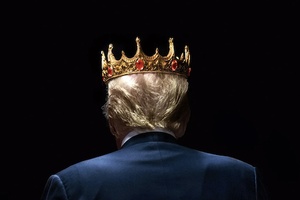
As July 4, 2026, approaches, the United States will both celebrate the 250th anniversary of the Declaration of Independence and experience its gravest political crisis since the Civil War. In barely a year since Donald J. Trump regained power, he and his allies have brazenly violated centuries-old Constitutional dictates, laws, and norms with impunity. How could he have accomplished this unprecedented feat so quickly and with so little resistance?
The theoretical rationale for the constitutional framework
The most authoritative analysis of the theoretical rationale for the Constitution is the Federalist Papers, written by influential members of the Constitutional Convention that drafted the Constitution. In Federalist Paper no. 51, James Madison identified the challenge that the new system was designed to overcome: “…[W]hat is government itself but the greatest of all reflections on human nature? If men were angels, no government would be necessary. If angels were to govern men, neither external nor internal controls on government would be necessary. In framing a government which is to be administered by men over men, the great difficulty lies in this: You must first enable the government to control the governed; and in the next place, oblige it to control itself.” The key mechanisms for creating an effective and self-controlled government were inspired by Montesquieu and Locke: delegating to the state only those powers enumerated by the Constitution, as well as creating a system of institutional checks and balances within the national government. The latter involved partially separating the core functions of the state — (a) the making (b) and the execution of government policy, as well as (c) the adjudication of disputes/conflicts — and embodying each function in a separate institution. Madison claimed that this institutional design would prevent state over-reach by “contriving the interior structure of the government, as that its several constituent parts may, by their mutual relations, be the means of keeping each other in their proper place.”[i]
For over two centuries, this system mostly functioned as designed, producing governments (and governors): (a) dependent on the people; (b) yet chosen indirectly rather than via direct democracy; and (c) because of the system of check and balances, as well as of federalism, dispersing state power to avoid despotism.[ii] However, Donald Trump has amply demonstrated that this system is not self-regulating; it requires political leaders who either (a) voluntarily choose to comply with the letter of the Constitution and laws as well as with its spirit, that is, informal norms dictating self-restraint, or (b) are checked by leaders of other political institutions. How then to explain why Donald Trump has so swiftly and successfully circumvented these structural features and become a despot?[iii]
The system created at the Constitutional Convention in Philadelphia in 1787 was not static. Two fundamental changes have occurred since the founding period. The first has been a partial liberalization and democratization of the deeply inegalitarian and unjust constitutional structure created in 1787.[iv] The hypocritical, albeit implicit, tension at the heart of the Constitution, is symbolized by the fact that Thomas Jefferson, author of the stirring opening words of the Declaration of Independence, “We hold these truths to be self-evident, that all men are created equal…” was the “owner” of 600 enslaved people. The Constitution implicitly protects slavery, private property, and class and gender inequality. There has been an overall movement since the founding, albeit with significant reversals (notably, the present one), toward greater liberalization and democratization by granting citizenship and social rights to the propertyless, women, and racial minorities.[v]
Second, power has steadily migrated from Congress to the presidency. The Constitution mandates that, in the domestic sphere, the president should do what the word “executive” implies—execute Congress’ policies. Although the president is delegated substantial powers, most are intended to ensure that the president “faithfully execute[s]” the laws passed by Congress. Presidential over-reach did not begin with Trump: he has followed in the footsteps of many previous presidents albeit going immeasurably further that his predecessors in aggrandizing his own power and that of the executive branch at the expense of Congress.[vi] He has also abused this power to engage in an unprecedent degree of lawlessness, destruction, and corruption. A combination of institutional factors and Trump’s boundless thirst for power have laid the groundwork for what might plausibly be described as a coup d’état.
What has facilitated Trump’s usurpation?
Donald Trump has achieved this feat by replacing the constitutionally mandated separation and division of powers with the integration of powers under his control. What flaws in the U.S. political system have enabled him to do so? Five factors help explain this outcome. First, in his second term Trump appointed complete sycophants to cabinet and other high-level executive positions. By contrast, in his first term, his subordinates blocked his most radical dictates. Second, thanks to the energetic support of these subordinates, who direct the powerful agencies of the executive, Trump has achieved near-total dominance over the executive and semi-independent agencies and commissions, as well as nearly full power over Congress, substantial cooperation from the judiciary, and ample power over civil society. Third, he further leveraged his control by becoming undisputed leader of a powerful political party—an institution whose existence was not foreseen in the Constitution.[vii] When the Republican Party (GOP) gained control (albeit by a slim margin) over both houses of Congress in the 2024 elections, Trump was feed from the shackles of congressional oversight and accountability. Fourth, because the GOP controls a majority of state governments, Trump undermined the division of power between the national and state governments.
The fifth and possibly most important factor is Trump’s personality. He is undoubtedly the most narcissistic, corrupt, coarse, and unethical president in American history. As a Constitutional scholar has observed, “The health of the American experiment rests far more on the integrity of any given president than we realized.”[viii] Nor does the unshackled Trump feel the need to provide the compliment (of hypocrisy) that La Rochefoucauld claimed vice might need to pay to virtue. When asked in a recent interview if there are limits to his power, he bragged, “Yeah, there is one thing. My own morality. My own mind. It’s the only thing that can stop me.”
What means were used to achieve despotism in America?
Trump has thus far prevented or stifled most attempts to hold him accountable. To begin with, as described above, he has rendered Congress supine. The GOP caucus has remained mostly united, thereby thwarting congressional oversight, since congressional rules give little power to the minority party. As for the judiciary, although many federal and state judges have nullified or delayed implementation of Trump’s initiatives, Trump-appointed and other Republican-appointed judges have overwhelmingly ruled in his favor. Moreover, the Supreme Court, the apex of the judicial branch, is dominated by a super-majority of ultra-reactionary justices appointed by Trump and other Republican presidents. It awarded Trump carte blanche by a 2023 decision granting presidents absolute immunity from criminal liability for actions relating to their core official functions. The Court has mostly overruled lower court decisions that would block Trump’s actions.[ix]
Partly as a result of the GOP’s control of Congress and the judiciary’s mixed record blocking Trump, the Democratic Party is poorly equipped to check his actions. With that said, Democratic Party leaders, with few exceptions, have mounted muted and ineffective resistance to Trump’s over-reach.
The Constitution presumably constitutes the bulwark that should restrain tyranny. However, armed with his newly gained power, Trump has exploited ambiguities, contradictions, and silences of the two and a half centuries-old and rarely amended Constitution to arbitrarily redefine legal terms to justify his decisions. For example, he has manufactured imaginary crises and invoked emergency powers by falsely claiming that the U.S. is being “invaded” by migrants, and that the U.S. is at war with drug cartels because of the fentanyl crisis. He has threatened to invoke the 1807 Insurrection Act to unleash federal troops to suppress popular protest. He has claimed that the International Economic Emergency Act of 1977 empowers him to regulate tariffs, a power constitutionally reserved to Congress save in a genuine economic emergency. He has warned of a tidal wave of criminal violence in Democratic-controlled cities (in fact, violent crimes have plummeted) to assert control over state militias despite governors’ opposition. In many cases, he has acted without bothering to invoke legal authority, such as when he violated a congressional requirement for consulting Congress before destroying and rebuilding the East Wing of the White House.
Although Trump is the most unpopular president in a century, grassroots protest has been relatively limited, perhaps because of the shock and bewilderment created by his dizzying array of initiatives. However, opposition has recently burgeoned as Americans witness and experience the catastrophic damage that his actions have caused. Opposition to Trump will surely accelerate if the Democratic Party gains control of one or both houses of Congress in the 2026 midterm elections. And yet, to conclude on a cautionary note, the attempted insurrection of January 6th, 2021, suggests that one should not underestimate Trump’s determination to violate legal procedures that threaten his retaining power. Given the GOP’s likely defeat in the 2026 midterms, Trump’s actions on January 6, 2021, may presage an attempt to postpone the November election or falsify its outcome. And this time, his subordinates are more likely than in 2021 to heed his corrupt dictates.
Did you enjoy this article? close




[i] In addition, the Tenth Amendment of the Constitution created federalism by dividing state power between the national and state governments.
[ii] This claim is squarely contradicted by massive extent of governmental injustice, including the massacre of Native Americans, protection of slavery, and repression of workers, immigrants, people of color, and women. These actions were taken by duly chosen governments. U.S. external relations are another realm characterized by repressive state policies and practices. While Trump’s 2024 campaign advocated a more modest profile internationally, his recent actions reflect a neo-imperialist orientation evident in many past U.S. foreign policies and actions. These issues require extended analysis.
[iii] This article will describe how Trump has gained arbitrary and mostly unchecked power—not what use he has made of it by pursuing his destructive agenda.
[iv] An important goal of the Framers, as Madison discussed in Federalist no. 10, was to design political machinery that would prevent the largest faction in the society—the poor—from uniting to threaten the affluent.
[v]However, even the most significant reforms failed to substantially diminish socioeconomic and racial inequalities.
[vi] See my previous Telos articles for a discussion of early stages of the process. In particular, the slow-motion coup which I analyzed in my article of May, 2021, is far closer to fruition.
[vii] The Framers strongly opposed the possibility of political parties, what they called factions. Indeed, the Constitution was designed precisely to prevent their emergence. The classic warning is Federalist Paper no. 10.
[viii] David French, “Renee Good Didn’t Know That She Had Crossed a Line,” The New York Times, January 21, 2026.
[ix] By so doing, it enabled the Trump administration to weaponize executive agencies for personal, partisan, and corrupt purposes that have included targeting opponents in the political, academic, cultural, scientific, and economic spheres. So much for Tocqueville’s admiration for the vibrancy and autonomy of American civil society.